Learn About Aerospace Manufacturing: Comprehensive Overview, Knowledge, and Key Insights
Aerospace manufacturing involves the design, production, and assembly of aircraft, spacecraft, satellites, and related systems. It combines advanced engineering, materials science, and manufacturing technologies to produce components that can operate under extreme conditions such as high speed, altitude, and temperature variations.
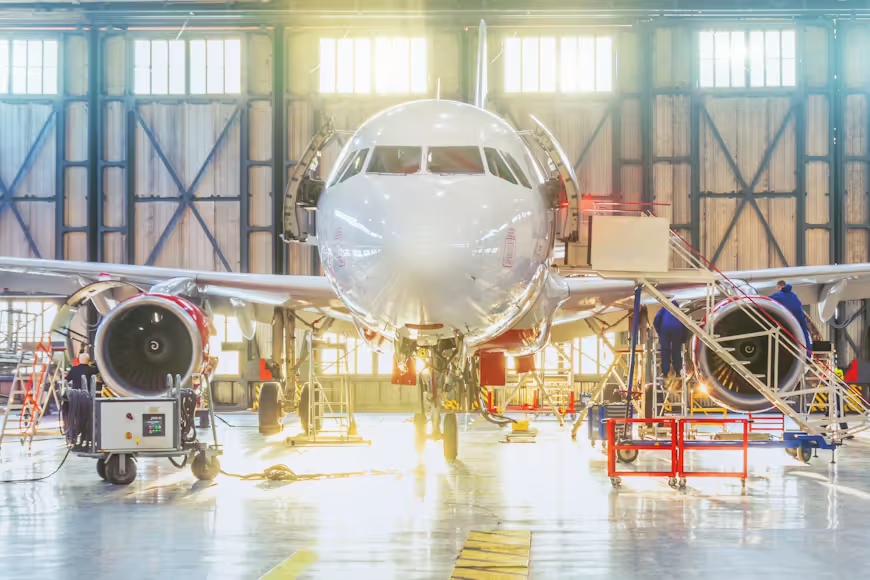
This industry exists to meet global needs for safe air transportation, space exploration, communication systems, and defense technologies. The sector integrates a wide range of disciplines - from precision machining and electronics to aerodynamics and propulsion systems - to deliver reliable aerospace platforms.
Aerospace manufacturing forms the technological backbone of modern aviation and space industries. Every aircraft, satellite, or rocket is the result of years of collaborative design and precision manufacturing. Without it, international connectivity, weather forecasting, navigation, and defense operations would not be possible.
Importance: Why it matters today, who it affects, and what problems it solves
Why it matters
-
Global connectivity: Enables commercial aviation, linking countries and supporting trade, tourism, and humanitarian efforts.
-
National defense and security: Produces aircraft and spacecraft for surveillance, transport, and strategic defense operations.
-
Innovation and technology: Drives advancements in automation, robotics, composite materials, and digital manufacturing.
-
Sustainability goals: Encourages lightweight materials and efficient engines to reduce emissions and environmental impact.
Who it affects
-
Manufacturers and suppliers of aerospace systems, including tier-1 and tier-2 component makers.
-
Airlines, cargo operators, and satellite companies that depend on reliable products.
-
Governments, defense agencies, and regulatory bodies ensuring national safety and compliance.
-
Engineering professionals, scientists, and researchers driving the field forward.
-
The general public, who benefit from safer, more efficient air travel and advanced communication systems.
What problems it solves
-
Efficiency and reliability: Produces precise components that ensure flight safety and operational reliability.
-
Global infrastructure: Supports communication, navigation, and surveillance through satellite manufacturing.
-
Environmental challenges: Promotes cleaner production, advanced materials, and fuel-efficient designs.
-
Economic growth: Generates export value, skilled employment, and innovation opportunities in technology sectors.
Recent Updates: Changes, trends, and news from the past year
Over the past year, aerospace manufacturing has experienced notable shifts driven by global demand, digital transformation, and sustainability initiatives.
-
Supply chain resilience: Following disruptions in recent years, manufacturers are localizing suppliers and using digital platforms to improve transparency and delivery speed.
-
Additive manufacturing expansion (2024-2025): 3D printing of aircraft components, engine parts, and interior structures is becoming mainstream, reducing waste and speeding up production cycles.
-
Sustainability push: Companies are adopting carbon-neutral processes, circular manufacturing, and recyclable materials as part of their 2025 sustainability targets.
-
Digital manufacturing and AI integration: Artificial intelligence and machine learning are being applied in design simulation, defect prediction, and quality assurance.
-
Focus on speed and flexibility: A 2025 industry survey found manufacturers increasingly prioritizing production speed and adaptability to meet global aircraft demand.
-
Emerging markets: Nations like India, Brazil, and the UAE are investing heavily in domestic aerospace manufacturing to reduce import dependence and strengthen strategic autonomy.
Table: Key Trends Shaping Aerospace Manufacturing (2024–2025)
| Trend | Impact |
|---|---|
| Digital manufacturing & AI | Enhanced design accuracy, real-time monitoring, and reduced rework |
| Additive manufacturing | Lightweight, complex structures and shorter lead times |
| Supply chain diversification | Reduced dependence on single-region suppliers |
| Sustainability & decarbonisation | Adoption of cleaner materials and processes |
| Advanced composites | Improved strength-to-weight ratios in aircraft and spacecraft |
Laws or Policies: How aerospace manufacturing is regulated
Aerospace manufacturing operates under strict national and international regulations to ensure safety, quality, and compliance.
-
Quality management standards: The AS9100 series of standards governs quality assurance, product traceability, and supplier management across the aerospace industry.
-
Export control regulations: Governments enforce export control laws such as the International Traffic in Arms Regulations (ITAR) or equivalent frameworks to prevent misuse of sensitive aerospace technologies.
-
Environmental regulations: Manufacturing and rework facilities must comply with air-quality and emission standards set by national environmental agencies to limit hazardous materials and pollutants.
-
Industrial and defense policies: Many countries promote domestic aerospace manufacturing under national industrial missions, emphasizing technology transfer, innovation, and component localization.
-
Safety certification: Aircraft components and systems must be certified by aviation authorities such as the FAA, EASA, or national equivalents before entering service.
These policies collectively ensure that aerospace manufacturing meets the highest standards of reliability, safety, and sustainability while protecting strategic interests.
Tools and Resources: Helpful tools, websites, and reference materials
Below are some useful resources and tools commonly used in aerospace manufacturing and education:
-
Design and simulation software: Tools like CATIA, Siemens NX, and ANSYS are widely used for 3D modeling, structural simulation, and component testing.
-
Additive manufacturing platforms: Software such as Autodesk Fusion and Materialise Magics help optimize 3D printing of aerospace parts.
-
Material databases: Composite and alloy material libraries provide verified performance data for aerospace applications.
-
Standards and certification bodies: International Aerospace Quality Group (IAQG) and national aviation authorities publish updated compliance and audit requirements.
-
Learning platforms: Universities and open online courses offer modules on aerospace materials, propulsion, and sustainable manufacturing.
-
Industry reports and journals: Annual aerospace outlooks and technical papers provide insights into current production, R&D, and innovation trends.
Sample Graph: Digital Adoption in Aerospace Manufacturing (2024–2025)
| Technology | Adoption Level |
|---|---|
| Additive manufacturing | High |
| Artificial intelligence | Moderate to High |
| Robotics and automation | High |
| Data analytics | Moderate |
| Cloud-based collaboration | Increasing rapidly |
FAQs
Q1: What makes aerospace manufacturing different from other manufacturing industries?
A: It requires extremely precise production methods and strict quality control because even small defects can affect safety. Every component must meet certified standards for strength, temperature tolerance, and reliability.
Q2: How are sustainability and green technologies influencing aerospace manufacturing?
A: Manufacturers are focusing on reducing waste, improving energy efficiency, and using lightweight materials like carbon fiber and titanium alloys to lower fuel consumption and emissions.
Q3: What role does additive manufacturing play in aerospace?
A: Additive manufacturing, or 3D printing, allows engineers to design complex parts with less material waste, enabling faster prototyping and customization of components.
Q4: What are the biggest challenges currently facing aerospace manufacturing?
A: Key challenges include supply chain instability, material shortages, workforce skill gaps, and the need to balance speed with regulatory compliance and safety.
Q5: How is artificial intelligence being used in aerospace manufacturing?
A: AI helps predict equipment maintenance, optimize design, monitor production quality, and reduce downtime, improving overall efficiency and precision.
Conclusion
Aerospace manufacturing stands at the intersection of innovation, safety, and global mobility. It continues to evolve through new materials, automation, artificial intelligence, and sustainability initiatives. As nations invest in domestic production and digital transformation, the sector’s importance extends beyond aviation - impacting space exploration, defense readiness, and environmental goals.
Understanding aerospace manufacturing means recognizing its role not just as an industrial activity, but as a foundation for technological progress, international cooperation, and a more connected world.

