Network Cameras: A Complete Guide to IP Security Camera Technology
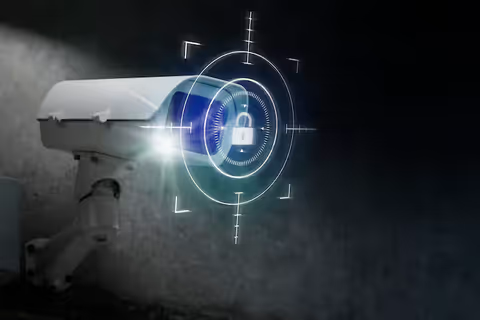
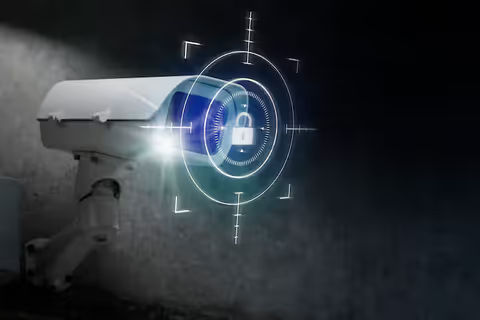
Network cameras are digital cameras that connect to a computer network to transmit video and, in many cases, audio and event information. Unlike traditional analog CCTV cameras, network cameras can communicate through Ethernet or wireless networks and can be managed using network-based software. Many modern systems use Internet Protocol (IP), which is why they are also commonly called IP security cameras.
How Network Cameras Work
IP Camera Connectivity
A network camera captures video and converts it into a digital stream that can travel across a local network. The video can then be viewed through compatible software, a web interface, a video management system (VMS), or a network video recorder (NVR). Technologies such as H.264 and H.265 are commonly used to compress video while reducing the amount of network bandwidth required.
Power over Ethernet
Power over Ethernet (PoE) allows compatible cameras to receive electrical power and transmit network data through the same Ethernet cable. This can simplify network camera installation because separate power wiring may not be necessary at every camera location. PoE infrastructure normally includes compatible network switches or other PoE equipment.
Types of Network Cameras
Fixed Network Cameras
Fixed cameras monitor a specific viewing area and are commonly used where a consistent field of view is required. Dome and bullet designs are frequently used for indoor and outdoor surveillance applications.
PTZ Network Cameras
Pan-tilt-zoom cameras allow the viewing direction and optical zoom to be controlled remotely. They can be useful for monitoring larger areas where a fixed camera may not provide sufficient coverage.
Wireless Network Cameras
Wireless IP cameras transmit video through a wireless network rather than requiring an Ethernet data connection. Network capacity, signal strength, encryption, and installation environment are important considerations for wireless deployments.
Important Network Camera Features
Resolution and Image Quality
Camera resolution affects the amount of visual detail captured in an image. HD, Full HD, 4K, and other resolutions are available across different network camera models. Higher resolution can provide more detail, but it can also increase storage and bandwidth requirements.
Night Vision and Low-Light Performance
Many security camera systems include infrared illumination or other low-light technologies. These features can help cameras produce usable images when ambient lighting is limited. Actual performance depends on the camera design, lens, scene, and environmental conditions.
Motion Detection and Video Analytics
Modern network cameras may support motion detection and video analytics. Depending on the system, analytics can identify movement, people, vehicles, or other predefined events. These functions can help reduce the amount of footage that requires manual review.
Network Cameras and NVR Systems
A network video recorder, or NVR, can receive video streams from compatible IP cameras and store recordings for later review. Compatibility should be checked before deployment because cameras and recording systems can differ in supported protocols, codecs, resolution, storage formats, and features.
ONVIF standards can help improve interoperability between compatible network video products. ONVIF develops specifications for network-based security products and provides profiles that define specific interoperability capabilities.
Network Camera Storage
Local Storage
Some network cameras support memory cards for local recording. This approach can provide storage directly at the camera, although available capacity and recording duration depend on the storage medium and video settings.
NVR Storage
An NVR can centralize recordings from multiple cameras. Storage requirements depend on factors such as camera resolution, frame rate, compression, number of cameras, recording schedule, and retention period.
Cloud Video Storage
Some network camera systems can transmit recordings or events to cloud-based platforms. Cloud architectures can provide remote access, but organizations should consider account security, data protection, network connectivity, and retention requirements.
Network Camera Cybersecurity
Network cameras are connected devices, so cybersecurity should be considered during installation and ongoing maintenance. ONVIF recommends measures such as avoiding unnecessary Internet exposure, separating CCTV networks with VLANs, using firewalls, limiting open ports, applying firmware updates, and using strong unique credentials.
Password and Access Management
Default credentials should be replaced with strong, unique credentials. Access should also be limited according to user responsibilities. Where supported, additional authentication controls can provide another layer of protection.
Firmware and Security Updates
Camera firmware can contain security fixes as well as performance improvements. Maintaining an inventory of camera models and firmware versions can help organizations manage updates more systematically.
Network Segmentation
Separating surveillance equipment from other business systems can limit unnecessary communication between devices. VLANs, firewalls, and access-control rules can be used to control network traffic. NIST security guidance similarly emphasizes network zoning and limiting communications to what is necessary.
Factors to Consider When Choosing Network Cameras
Before deploying a network camera system, consider the intended viewing area, lighting conditions, resolution requirements, network infrastructure, storage requirements, camera compatibility, cybersecurity controls, and future expansion.
For larger deployments, it is also useful to document camera locations, IP addresses, firmware versions, recording requirements, and authorized users. This creates a clearer foundation for maintenance and security management.
Benefits of Network Camera Technology
Network cameras can provide centralized video management, digital recording, remote monitoring, flexible network connectivity, and integration with other security technologies. Their ability to operate as network devices also makes them suitable for modern video surveillance architectures.
However, network connectivity also introduces cybersecurity and privacy considerations. Proper configuration, access management, software maintenance, and network protection are therefore important parts of a complete surveillance strategy.
Conclusion
Network cameras have become an important part of modern video surveillance because they combine digital imaging with network connectivity. Technologies such as IP networking, PoE, NVR recording, ONVIF interoperability, video analytics, and cloud connectivity provide different approaches for designing surveillance systems. Understanding resolution, storage, networking, compatibility, and cybersecurity can help users evaluate network camera technology and develop an appropriate system for their environment.