Water Filtration: A Complete Guide to Clean Water Treatment and Filtration Systems
Water filtration is a treatment process used to reduce unwanted particles, chemicals, microorganisms, and other contaminants from water. Depending on the water source and the contaminants present, different filtration technologies may be used.
Water filtration can range from simple mechanical filters to advanced systems such as activated carbon filtration, ultrafiltration, nanofiltration, reverse osmosis, and ultraviolet treatment. The appropriate technology depends on water quality and the specific contaminants that need to be addressed.
Why Is Water Filtration Important?
Water quality can vary considerably between municipal supplies, groundwater, wells, surface water, and other sources. Contaminants can include suspended particles, minerals, metals, organic chemicals, and microorganisms.
Modern water treatment systems are designed around specific water-quality requirements rather than a single technology that removes everything.
Important considerations include:
- Source of the water
- Known contaminants
- Water hardness
- Sediment levels
- Microbiological quality
- Dissolved minerals
- Existing municipal treatment
- Intended use of the water
The EPA identifies several technologies used to address chemical and biological contaminants in drinking water, including filtration, activated carbon, ion exchange, reverse osmosis, and ultraviolet treatment.
How Does Water Filtration Work?
Mechanical Filtration
Mechanical filtration physically captures particles as water passes through a filter medium.
These systems can help reduce materials such as:
- Sand
- Sediment
- Rust particles
- Dirt
- Suspended solids
The effectiveness depends on the filter's pore size, construction, flow conditions, and maintenance requirements.
Activated Carbon Filtration
Activated carbon is a porous material with a large internal surface area. It works primarily through adsorption, allowing certain compounds to attach to the carbon surface.
Activated carbon can be useful for reducing certain:
- Chlorine-related taste and odor
- Volatile organic compounds
- Synthetic organic compounds
- Disinfection byproduct precursors
However, performance varies according to the carbon material, water chemistry, contaminant characteristics, and system design.
Reverse Osmosis
Reverse osmosis (RO) uses pressure to push water through a semipermeable membrane. The membrane separates treated water from a concentrated reject stream.
RO technology can address a broad range of contaminants, including many dissolved solids, inorganic compounds, radionuclides, and synthetic organic chemicals.
Because reverse osmosis is a membrane-based process, it requires appropriate pressure, pretreatment in many applications, and regular membrane maintenance.
Ultraviolet Water Treatment
Ultraviolet treatment uses UV energy to inactivate microorganisms in water. NSF describes different UV treatment categories, including systems designed for microbiologically contaminated water and systems intended for supplemental treatment of already disinfected water.
UV treatment is different from conventional filtration because it does not primarily remove dissolved substances or physical particles.
Major Types of Water Filtration Systems
Point-of-Use Filtration
Point-of-use systems treat water at a specific location, such as a kitchen faucet, countertop, or drinking-water dispenser.
Examples include:
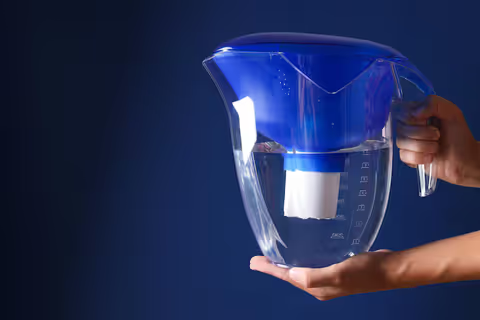
- Water filter pitchers
- Faucet-mounted filters
- Countertop filtration systems
- Under-sink filtration systems
- Reverse osmosis systems
Point-of-Entry Filtration
Point-of-entry systems treat water as it enters a building or property.
These systems are commonly considered when water quality concerns affect multiple outlets throughout a building.
Whole-House Water Filtration
Whole-house systems are designed to treat water before it reaches multiple fixtures.
Depending on the application, a system may combine sediment filtration, activated carbon, water softening, membrane treatment, or other technologies.
Industrial Water Filtration
Industrial water filtration involves larger-scale treatment systems designed for manufacturing, processing, cooling, boiler applications, and other industrial processes.
Industrial water treatment may involve several stages because different processes require different water-quality characteristics.
Common Water Filtration Technologies
| Technology | Primary Function | Typical Application |
|---|---|---|
| Sediment filtration | Reduces suspended particles | Residential and industrial |
| Activated carbon | Adsorbs selected organic compounds | Drinking water treatment |
| Ion exchange | Changes selected dissolved ions | Water softening and specific contaminants |
| Ultrafiltration | Membrane separation | Drinking and process water |
| Nanofiltration | Membrane separation | Hardness and selected dissolved contaminants |
| Reverse osmosis | Broad dissolved-contaminant reduction | Drinking and industrial water |
| UV treatment | Microbial inactivation | Drinking water treatment |
| Distillation | Vaporization and condensation | Specialized water treatment |
The actual contaminant-reduction capability depends on the specific system and certification rather than the technology name alone.
Water Contaminants and Filtration
Sediment and Suspended Particles
Sediment can enter water through soil, corrosion, pipes, or other sources. Mechanical filtration is commonly used to capture these larger particles.
Chlorine and Taste or Odor Compounds
Activated carbon systems are commonly used to reduce certain substances associated with chlorine, taste, and odor.
NSF/ANSI 42 covers treatment systems designed for aesthetic effects such as chlorine, taste, odor, and particulate reduction.
Lead and Other Health-Related Contaminants
Some certified filtration systems are designed to reduce specific health-related contaminants.
NSF/ANSI 53 covers specific health-effect contaminant reduction claims, including certain systems certified for lead, VOCs, chromium, and other contaminants. Certification should always be checked for the particular contaminant rather than assumed for every filter.
PFAS
PFAS are a group of persistent chemicals that have received increasing attention in drinking-water research and regulation.
Not every water filter reduces PFAS. EPA recommends identifying whether PFAS are present and, when filtration is appropriate, selecting a system certified for the relevant PFAS reduction claim.
Understanding Water Filter Certifications
NSF/ANSI 42
NSF/ANSI 42 addresses aesthetic effects. Depending on the specific certification, systems may have claims related to chlorine, taste, odor, particulate matter, and certain other substances.
NSF/ANSI 53
NSF/ANSI 53 covers drinking-water treatment systems with specific health-related contaminant reduction claims.
A certification does not mean that a filter removes every contaminant. Consumers should check the exact contaminant-reduction claim associated with the certified system.
NSF/ANSI 58
NSF/ANSI 58 applies to reverse osmosis drinking-water treatment systems. These systems use semipermeable membranes and may include additional filtration stages.
NSF/ANSI 401
NSF/ANSI 401 addresses selected emerging or incidental contaminants, including certain pharmaceuticals, pesticides, and chemical compounds.
How to Choose a Water Filtration System
Test or Identify the Water Quality
The first step is understanding the water that needs treatment. A water-quality report or appropriate laboratory testing can help identify potential contaminants.
For private wells and other individual water sources, testing can be particularly important because water quality may vary over time.
Identify the Target Contaminants
A filtration system should be selected according to the contaminants that need to be reduced.
For example, a system intended to reduce sediment may not be designed to address dissolved chemicals, while a carbon filter may not provide the same treatment as a reverse osmosis membrane.
Check the Certification
Look for certification that specifically corresponds to the contaminant of concern.
NSF recommends checking both the applicable standard and the individual contaminant-reduction claim because certification to one standard does not mean that a system reduces every possible contaminant.
Consider Water Flow and Capacity
Filtration systems have different flow rates and treatment capacities. A household system and an industrial water treatment system have very different requirements.
Important technical factors include:
- Flow rate
- Filter capacity
- Operating pressure
- Water temperature
- Filter life
- Membrane life
- Replacement requirements
Water Filtration Maintenance
Replace Filter Cartridges
Filters eventually reach their capacity and need replacement. Continuing to use an exhausted filter can reduce treatment performance.
Manufacturers normally provide replacement schedules or indicators for specific systems.
Maintain Reverse Osmosis Membranes
RO systems typically contain multiple filtration stages and a membrane. Both cartridges and membranes require appropriate maintenance.
EPA notes that the effectiveness of certain point-of-use filtration systems depends on maintaining them according to the manufacturer's instructions.
Clean the System Properly
Storage tanks, housings, tubing, and other components should be maintained according to the system's instructions.
Good maintenance helps preserve filtration performance and system hygiene.
Water Filtration vs Water Purification
Water filtration and water purification are related but are not identical terms.
Filtration generally refers to processes that remove or reduce contaminants through physical separation, adsorption, membranes, or related mechanisms.
Purification can refer more broadly to treatment processes designed to address contaminants, including microorganisms and chemical substances.
For example, UV technology is used for microbial inactivation, while reverse osmosis uses membrane separation to reduce many dissolved contaminants.
Residential and Commercial Water Treatment
Residential Water Treatment
Residential systems are generally designed around household drinking water and other domestic requirements.
Common technologies include:
- Sediment filters
- Activated carbon
- Water softeners
- Reverse osmosis
- UV treatment
- Combination filtration systems
Commercial Water Treatment
Commercial buildings may require larger treatment capacities because water demand can be substantially higher.
Hotels, offices, restaurants, healthcare facilities, laboratories, and other buildings may have different water-quality requirements depending on their operations.
Industrial Water Treatment
Industrial applications can require specialized processes for process water, boiler water, cooling systems, manufacturing, and wastewater treatment.
The treatment design depends heavily on the industry's water chemistry and operational requirements.
Benefits and Limitations of Water Filtration
Potential Benefits
Properly selected filtration technology can:
- Reduce specific contaminants
- Improve certain taste and odor characteristics
- Reduce suspended particles
- Support drinking-water quality objectives
- Provide targeted treatment for specific water-quality concerns
Important Limitations
No single filtration technology is designed to remove every contaminant.
A filter's performance depends on its design, certification, water chemistry, operating conditions, and maintenance. NSF specifically emphasizes that certification does not mean a treatment system reduces all possible contaminants.
Future of Water Filtration Technology
Water treatment research continues to address emerging contaminants, resource efficiency, membrane technologies, and advanced treatment processes.
Research and development areas include:
- Advanced membrane filtration
- Improved activated carbon technology
- PFAS treatment
- Energy-efficient water treatment
- Smart water-quality monitoring
- Advanced oxidation
- Improved industrial water reuse
- Sustainable filtration media
EPA research currently includes treatment approaches for contaminants such as PFAS, lead, algal toxins, disinfection byproducts, nitrate, arsenic, and microbial contaminants.
Conclusion
Water filtration is an important part of modern water treatment technology, but the appropriate system depends on the quality and intended use of the water. Mechanical filtration, activated carbon, ion exchange, membrane filtration, reverse osmosis, and UV treatment each address different treatment requirements.
The most important consideration is to identify the specific water-quality issue and select a technology with appropriate performance evidence or certification. Regular maintenance and timely filter replacement are also essential for maintaining expected performance.