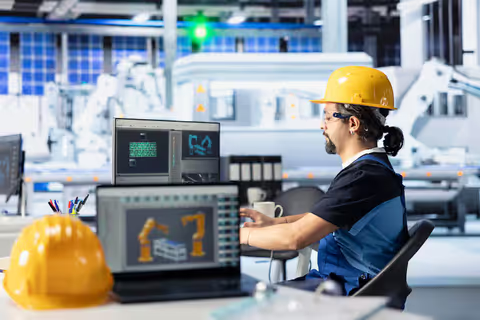
Industrial Process Control Systems: Exploring Automation, Monitoring and Control Methods
Industrial Process Control Systems are technologies used to monitor, regulate, and coordinate physical processes in manufacturing plants, power facilities, water treatment operations, chemical production, food processing, and other industrial environments.
These systems connect sensors, controllers, software, communication networks, and field equipment so that process conditions can be observed and adjusted according to defined operating requirements.
The development of industrial process control began with mechanical and pneumatic control methods. As electronic instrumentation became more common, analog controllers and measurement devices provided greater precision. Digital technologies later introduced programmable logic controllers (PLCs), distributed control systems (DCS), supervisory control and data acquisition (SCADA), industrial computers, and networked control platforms.
How industrial process control works
A typical control system follows a continuous cycle: measure a process condition, compare the measurement with a desired value, calculate an appropriate response, and adjust equipment. For example, a temperature sensor may detect a change in a production vessel, while a controller determines whether heating equipment should increase or decrease its output.
The basic components include sensors, transmitters, controllers, actuators, human-machine interfaces (HMIs), communication networks, and supervisory software. Each component has a specific role, but the components operate together as part of a larger control architecture.
Common types of control systems
Industrial facilities may use different control platforms depending on process complexity, equipment, and operational requirements.
- PLC systems are commonly used for sequential machine control and discrete manufacturing processes.
- DCS platforms are often associated with continuous or batch processes involving many interconnected control loops.
- SCADA systems provide supervisory monitoring and control across geographically distributed assets.
- Industrial PCs can run control, visualization, data-processing, and specialized automation applications.
- Safety instrumented systems are designed to perform defined protective functions when specified hazardous conditions occur.
The architecture may contain several of these technologies at the same facility.
Importance
Industrial Process Control Systems matter because many industrial processes require continuous monitoring of temperature, pressure, flow, level, speed, composition, voltage, current, or other variables. Manual observation alone may not provide the response speed or consistency required for complex operations.
Control systems also help operators understand what is happening inside equipment and process areas. Clear measurements and alarms can provide information when operating conditions move outside defined ranges.
Supporting stable operations
Many industrial processes depend on maintaining variables within specified operating ranges. A heating process, for example, may require a particular temperature profile, while a water-treatment process may depend on controlled flow and chemical conditions.
Automatic control can repeatedly apply defined control logic. This reduces dependence on manual adjustment for routine process changes, although operators remain important for supervision, abnormal situations, and system management.
Improving monitoring and safety
Industrial facilities can contain rotating equipment, high temperatures, high pressures, electrical systems, and hazardous materials. Control and monitoring systems can detect abnormal conditions and initiate predefined responses where the system architecture supports such functions.
Safety should not be confused with ordinary process control. A safety system has a specific protective purpose and is generally designed according to separate engineering and functional-safety requirements.
Managing industrial data
Modern control systems generate large quantities of operational data. Measurements can be recorded over time to help engineers understand process behavior, investigate abnormalities, evaluate equipment conditions, and analyze production patterns.
Important data categories may include:
| Data type | Example | Typical purpose |
|---|---|---|
| Process variable | Temperature | Process monitoring |
| Pressure measurement | Vessel pressure | Process control |
| Flow measurement | Water or gas flow | Material movement monitoring |
| Equipment status | Motor running/stopped | Operational awareness |
| Alarm record | High-pressure alarm | Event investigation |
| Historical trend | Temperature over time | Process analysis |
| Energy measurement | Electrical consumption | Energy monitoring |
Recent Updates
Industrial Process Control Systems have increasingly become connected with digital technologies. From 2024 through 2026, developments have generally focused on industrial networking, cybersecurity, data integration, advanced analytics, edge computing, artificial intelligence, and more flexible control architectures.
Greater IT and OT integration
Information technology and operational technology are becoming more interconnected. Production data may move from PLCs, DCS platforms, sensors, and industrial gateways into data platforms used for analysis and reporting.
This integration can improve visibility across different parts of a facility, but it also creates additional cybersecurity considerations. Network segmentation, access control, monitoring, authentication, and controlled remote connections have therefore received greater attention.
Edge computing and industrial analytics
Edge computing places data-processing capabilities closer to machines and control equipment. Instead of sending every measurement to a distant computing environment, selected information can be processed locally.
This approach can support applications where rapid analysis, local decision-making, or reduced network traffic is important. The exact architecture depends on process requirements and system design.
Artificial intelligence and machine learning
Artificial intelligence and machine learning are being explored for applications such as anomaly detection, predictive analysis, process optimization, and equipment monitoring. These technologies generally operate alongside established control architectures rather than replacing every conventional controller.
Human oversight remains important, particularly when analytical systems influence industrial decisions. Data quality, model validation, cybersecurity, and appropriate operating boundaries need to be considered.
Digital twins and simulation
Digital twins and process simulation models can represent physical equipment or processes in a digital environment. Engineers may use these models to examine process behavior, evaluate scenarios, or support training and planning.
The level of detail varies considerably. A simple model may represent a few process variables, while a complex digital representation can incorporate equipment states, historical information, and process relationships.
Laws or Policies
In India, Industrial Process Control Systems may be affected by requirements related to workplace safety, electrical systems, environmental protection, cybersecurity, and sector-specific industrial operations. The exact obligations depend on the type of facility and the processes being controlled.
The Ministry of Labour and Employment and related authorities provide frameworks concerning occupational safety. The Occupational Safety, Health and Working Conditions Code, 2020 is part of India's broader occupational safety framework, subject to its applicable implementation and rules.
Electrical and industrial requirements
Industrial control installations can involve electrical panels, motors, drives, instrumentation, and communication equipment. Applicable requirements may involve the Central Electricity Authority, Bureau of Indian Standards, state authorities, and sector-specific regulations.
Standards such as IEC 61131 are relevant to programmable controllers, while IEC 61508 and IEC 61511 are associated with functional safety and safety-related control applications. IEC 62443 provides a widely used framework for industrial automation and control-system cybersecurity.
Environmental and sector requirements
Facilities in sectors such as chemicals, power generation, water treatment, pharmaceuticals, food processing, and petroleum may have additional environmental or operational requirements. The Central Pollution Control Board and State Pollution Control Boards play important roles in India's environmental regulatory framework.
Control-system design therefore needs to consider the facility's process, equipment, safety requirements, environmental obligations, and applicable technical standards rather than relying on a single regulatory framework.
Tools and Resources
Several technical resources are relevant to understanding and managing Industrial Process Control Systems. The appropriate tools depend on whether the objective is system design, programming, simulation, monitoring, cybersecurity, or performance analysis.
Engineering and programming tools
PLC programming environments are used to create and test control logic. Common programming approaches include ladder diagrams, function block diagrams, structured text, and sequential function charts, depending on the controller and applicable standard.
Process simulation software can represent equipment and process behavior before physical implementation. HMI and SCADA development environments are used to create operator displays, alarms, trends, and supervisory functions.
Monitoring and analysis resources
Industrial facilities commonly use historians and databases to store time-series process information. Trend-analysis tools can then display temperature, pressure, flow, equipment states, and other measurements over selected periods.
Useful reference resources include:
- Bureau of Indian Standards publications
- Central Electricity Authority regulations and guidance
- Central Pollution Control Board resources
- IEC standards for automation and functional safety
- IEC 62443 resources for industrial cybersecurity
- ISA technical publications on industrial automation
- NIST cybersecurity guidance
- Manufacturer documentation for specific control hardware and software
Documentation is particularly important because control-system behavior depends on the actual architecture, configuration, software version, instrumentation, and operating procedures.
FAQs
What are Industrial Process Control Systems?
Industrial Process Control Systems are integrated technologies used to measure, monitor, and regulate industrial processes. They may include sensors, controllers, actuators, HMIs, networks, and supervisory software.
What are the main types of Industrial Process Control Systems?
Common types include PLC-based control systems, distributed control systems, and SCADA platforms. The selection depends on process characteristics, geographic distribution, equipment architecture, and control requirements.
How do Industrial Process Control Systems improve process monitoring?
They collect measurements from sensors and present information through control interfaces, alarms, trends, and historical records. This gives operators and engineers structured information about process conditions and equipment states.
What role does cybersecurity play in Industrial Process Control Systems?
Cybersecurity helps protect industrial control networks, controllers, operator stations, engineering systems, and connected devices from unauthorized access or disruption. Network segmentation, identity management, monitoring, secure configuration, and controlled remote access are among the relevant practices.
Are PLC and DCS systems the same?
No. Both are industrial control technologies, but they are commonly used in different architectures. PLCs are widely associated with machine and sequential control, while DCS platforms are frequently used for larger continuous or batch processes with many interconnected control loops.
Conclusion
Industrial Process Control Systems combine measurement, control, communication, software, and industrial equipment to regulate complex processes. Their role has expanded as facilities adopt connected networks, digital analytics, edge computing, artificial intelligence, and simulation technologies. At the same time, cybersecurity, functional safety, electrical requirements, and environmental regulations remain important considerations. Understanding the relationship between field devices, controllers, supervisory systems, and operational data provides a foundation for understanding modern industrial automation.