PLC Automation Systems: Insights Into Programming, Control and Automation
A PLC Automation Systems Guide explains how programmable logic controllers are used to monitor equipment, process input signals, execute programmed instructions, and control industrial machinery.
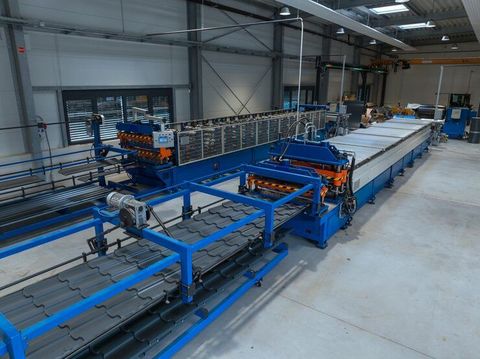
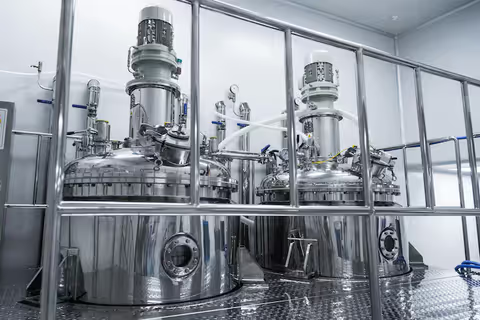
PLC automation systems are common in manufacturing plants, water treatment facilities, packaging lines, power systems, material-handling equipment, and process industries. By combining controllers, sensors, actuators, communication networks, and programming software, these systems coordinate industrial processes with repeatable control logic.
Context
What Is a PLC?
PLC stands for Programmable Logic Controller. It is an industrial computer designed to control machines and processes in environments where electrical signals, sensors, motors, valves, and other equipment must work together.
The development of PLC technology was closely connected with the need to replace large collections of hardwired relay circuits. Traditional relay-based control could perform logical operations, but changing the control sequence often required physical rewiring.
PLCs introduced programmable control logic. Instead of changing numerous physical connections, engineers could modify the program that determines how inputs and outputs interact.
How PLC Automation Systems Work
A PLC Automation System generally follows a repeating operating cycle. First, the controller receives information from connected input devices. It then processes that information according to the programmed logic before updating output devices.
For example, a sensor may detect that an object has reached a particular position. The PLC receives this signal, checks the programmed conditions, and may activate a motor, valve, cylinder, indicator, or another actuator.
A simplified PLC operating cycle includes:
- Reading input signals
- Processing the control program
- Updating output signals
- Communicating with connected devices
- Performing diagnostics and system checks
This cycle occurs continuously while the controller is operating.
Main Components of a PLC Automation System
A PLC system contains several components that work together. The central processing unit, or CPU, executes the control program and manages system operations.
Input modules receive signals from field devices such as switches, proximity sensors, temperature sensors, pressure transmitters, and encoders. Output modules transmit control signals to equipment such as motors, solenoid valves, contactors, lamps, and actuators.
Other components can include:
- Power supply
- CPU or processor
- Digital input modules
- Digital output modules
- Analog input and output modules
- Communication modules
- Human-machine interface
- Industrial network equipment
- Programming workstation
- Sensors and actuators
Digital and Analog Signals
Digital signals normally represent discrete states, such as on or off. A limit switch, for example, can indicate whether a machine component has reached a particular position.
Analog signals represent changing values. Temperature, pressure, flow, level, and speed can be represented using electrical signal ranges that the PLC converts into usable data.
| PLC Element | Main Function | Example |
|---|---|---|
| CPU | Executes programmed logic | Control sequence |
| Digital input | Reads discrete signals | Limit switch |
| Analog input | Reads variable signals | Pressure transmitter |
| Digital output | Controls discrete equipment | Motor contactor |
| Analog output | Produces variable control signal | Valve position |
| Communication module | Exchanges network data | Industrial Ethernet |
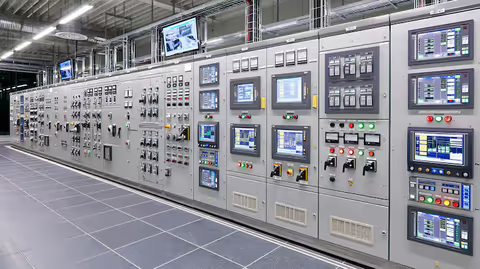
| HMI | Displays and accepts operator information | Touchscreen panel |
Importance
Why PLC Automation Systems Matter
PLC Automation Systems provide a structured way to coordinate industrial equipment. They can manage sequences involving many sensors, motors, valves, conveyors, pumps, heaters, and other devices.
Manufacturing processes often contain repeated operations. A PLC can execute programmed sequences consistently while collecting information from field equipment.
PLC systems are used across many sectors, including:
- Automotive manufacturing
- Food and beverage processing
- Packaging
- Chemical processing
- Water and wastewater treatment
- Power generation
- Material handling
- Building automation
- Pharmaceutical manufacturing
- Textile production
Improving Process Coordination
A PLC can coordinate several pieces of equipment according to defined conditions. For example, a packaging line may require a conveyor to move a product, a sensor to detect its position, a filling mechanism to operate, and a sealing mechanism to activate in a specific sequence.
The controller can manage these steps through programmed logic. Interlocks can prevent selected operations from occurring unless required conditions have been met.
Monitoring Industrial Equipment
PLC systems can also collect operating information. Inputs from sensors can be used to monitor temperature, pressure, position, flow, speed, and equipment states.
When connected to an HMI or supervisory system, this information can be displayed to operators. Historical data can also be stored when the control architecture includes appropriate data systems.
Challenges in PLC Automation
PLC installations require careful planning because industrial environments can contain electrical noise, temperature changes, vibration, moisture, dust, and other conditions that affect equipment.
Programming errors can also result in unexpected machine behavior. Incorrect sensor wiring, unsuitable signal ranges, communication failures, or poorly defined interlocks can affect system operation.
Important considerations include:
- Correct input and output mapping
- Appropriate control logic
- Electrical isolation
- Network configuration
- Emergency stopping arrangements
- Program documentation
- Access control
- Backup of controller programs
- Testing before operational use
Recent Updates
Greater Use of Industrial Networking
Modern PLC Automation Systems increasingly communicate through industrial Ethernet and other digital networks. Networking allows controllers to exchange information with HMIs, variable-frequency drives, remote I/O, robots, sensors, and supervisory systems.
Protocols such as PROFINET, EtherNet/IP, Modbus TCP, EtherCAT, and OPC UA can be used in different industrial architectures. The appropriate protocol depends on equipment compatibility and application requirements.
Integration With Industrial Data Systems
PLC data can increasingly be connected to supervisory control and data acquisition systems, manufacturing execution systems, databases, and industrial analytics platforms.
This integration allows process information to move beyond the controller itself. Production parameters, equipment states, alarms, and sensor measurements can be analyzed at different levels of a factory system.
Edge Computing and Data Processing
Some modern automation architectures place additional computing capability close to industrial equipment. Edge devices can process selected information near the machine before sending relevant data to higher-level systems.
This architecture can reduce unnecessary data transmission and support applications that require rapid local analysis. The exact architecture varies according to process requirements and network design.
Cybersecurity
As PLCs become more connected, cybersecurity has become an important part of industrial automation planning. Controllers and related systems can be exposed to risks when industrial networks are connected to broader enterprise or external networks.
Security measures can include network segmentation, controlled user access, secure configuration, software updates, monitoring, backups, and incident-response planning. IEC 62443 is one recognized family of standards addressing cybersecurity for industrial automation and control systems.
Digital Engineering and Simulation
Engineering teams increasingly use simulation and virtual testing to examine control sequences before physical equipment is placed into operation. Digital models can help examine logic, machine states, sensor behavior, and communication sequences.
These approaches can also support operator training and troubleshooting by providing a controlled environment for examining automation logic.
Laws or Policies
Industrial Automation in India
PLC Automation Systems used in India can be affected by workplace safety, electrical safety, environmental, machinery, and sector-specific requirements. The exact requirements depend on the facility, equipment, industry, and process.
The Occupational Safety, Health and Working Conditions Code, 2020 provides a broad legislative framework concerning occupational safety and working conditions, subject to its applicability and implementation framework.
Electrical installations may also be subject to applicable provisions under Indian electricity regulations and relevant technical standards. Industrial facilities need to assess the requirements that apply to their particular installation.
Standards for PLC Systems
Several international standards are relevant to programmable controllers and industrial automation. IEC 61131 is an important standards series associated with programmable controllers, including programming languages and controller-related requirements.
IEC 60204-1 addresses electrical equipment of machines, while IEC 61508 provides a framework for functional safety of electrical, electronic, and programmable electronic safety-related systems.
IEC 62443 addresses cybersecurity for industrial automation and control systems. These standards may be referenced during system design, engineering, testing, and documentation depending on the application.
Environmental and Sector Requirements
PLC-controlled equipment can be part of facilities subject to environmental requirements. Manufacturing plants, chemical facilities, water-treatment plants, and other industrial operations may have requirements administered by authorities such as the Central Pollution Control Board and State Pollution Control Boards.
The controller itself does not determine environmental compliance. Rather, it can form part of a larger system used to monitor or control processes that are subject to applicable environmental requirements.
Tools and Resources
PLC Programming Software
PLC manufacturers generally provide programming environments used to create, test, document, and transfer control programs. Programming commonly uses languages associated with IEC 61131-3, including Ladder Diagram, Function Block Diagram, Structured Text, Sequential Function Chart, and Instruction List in contexts where supported.
Ladder Diagram remains widely recognized because its structure resembles traditional relay-control logic. Structured Text is useful for more complex calculations and algorithmic operations.
Simulation and Testing Tools
PLC simulation software can model inputs, outputs, timers, counters, sequences, and selected machine behaviors without requiring every physical component to be connected.
Testing tools can also include multimeters, signal generators, network analyzers, electrical test equipment, and controller diagnostic interfaces. The appropriate instrument depends on the type of fault or measurement being investigated.
Documentation Resources
Clear documentation is an important part of PLC automation. Useful documents may include:
- Input and output lists
- Electrical schematics
- Network diagrams
- Control narratives
- PLC program backups
- Alarm lists
- Sequence descriptions
- Maintenance records
- Equipment manuals
- Change-control records
Technical references from IEC, ISO, the Bureau of Indian Standards, and equipment manufacturers can provide additional information about control systems, electrical design, machinery safety, and industrial communication.
FAQs
What Is a PLC Automation Systems Guide?
A PLC Automation Systems Guide explains the principles, components, programming methods, communication technologies, applications, and safety considerations associated with programmable logic controller-based automation.
How Do PLC Automation Systems Work?
PLC Automation Systems receive signals from sensors and other input devices, process those signals using programmed logic, and then control connected output devices. The controller repeats this process continuously during operation.
What Are the Main Components of PLC Automation Systems?
The main components generally include a CPU, power supply, input and output modules, communication interfaces, programming software, sensors, actuators, and an HMI or other operator interface where required.
Which Programming Languages Are Used in PLC Systems?
Common IEC 61131-3 programming approaches include Ladder Diagram, Function Block Diagram, Structured Text, and Sequential Function Chart. The languages available depend on the PLC platform and engineering environment.
Are PLC Automation Systems Used Outside Manufacturing?
Yes. PLC systems are also used in water treatment, power systems, building automation, food processing, transportation infrastructure, material handling, and other industrial applications where equipment must operate according to defined control sequences.
Conclusion
PLC Automation Systems use programmable controllers to receive input information, execute control logic, and operate connected industrial equipment. Their applications range from manufacturing and packaging to water treatment, energy systems, and material handling. Current developments include industrial networking, data integration, edge processing, cybersecurity, and simulation-based engineering. Applicable Indian requirements can involve workplace safety, electrical systems, environmental regulations, and technical standards depending on the specific installation.