How to Implement Silicone Molding Automation: Complete Guide
Learn how silicone molding automation increases production efficiency, reduces labor costs, and improves product consistency through advanced machinery and
Silicone molding automation represents a fundamental shift in manufacturing efficiency, replacing labor-intensive manual processes with precision-controlled machinery that delivers consistent results at scale. Modern automated systems integrate liquid silicone rubber injection, robotic part handling, automated curing cycles, and quality inspection technologies into unified production workflows. Manufacturers implementing these systems report production capacity increases of 300 to 500 percent, defect rate reductions below 2 percent, and significant labor cost savings. This comprehensive guide explores the technologies, implementation strategies, and practical decision-making frameworks that enable manufacturers to transform silicone production operations.
Core Benefits and Practical Limitations of Silicone Molding Automation
Automated silicone molding systems deliver measurable operational improvements across multiple dimensions. Production throughput increases dramatically because machines operate continuously without fatigue, processing parts 24 hours daily with consistent cycle times. A typical automated injection molding system completes cycles in 30 to 90 seconds depending on part complexity, compared to manual processes requiring 3 to 5 minutes per part. This translates to production increases of 300 to 500 percent on equivalent floor space.
Quality improvements stem from precise control of injection pressure, temperature, and curing duration. Manual processes introduce variability through inconsistent material loading, pressure application, and timing. Automated systems maintain tolerances within plus or minus 0.1 millimeters and reduce defect rates to below 2 percent compared to 5 to 15 percent in manual operations. This consistency reduces scrap material costs and eliminates expensive rework cycles.
Labor cost reduction represents a significant financial benefit. A single automated system replaces 2 to 4 full-time operators while requiring only 1 technician for monitoring and maintenance. Over a five-year period, labor savings typically exceed equipment costs by 200 to 300 percent. However, automation requires substantial upfront capital investment, ranging from 150,000 to 500,000 dollars depending on system complexity and production volume requirements.
Practical limitations include high initial equipment costs, extended payback periods of 2 to 4 years, and specialized technical expertise required for operation and maintenance. Smaller manufacturers with production volumes below 5,000 units annually may struggle to justify automation investments. Additionally, changeover times between different part designs can require 4 to 8 hours, making automation less suitable for highly customized, low-volume production.
Types of Silicone Molding Automation Systems
Liquid Silicone Rubber Injection Molding
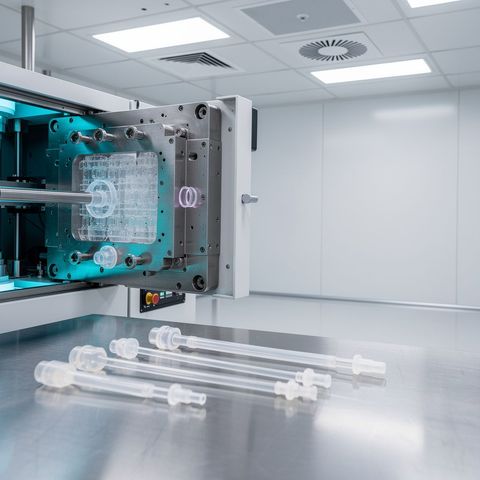
LSR injection molding systems dispense pre-catalyzed silicone compounds directly into closed molds under controlled pressure and temperature. These systems use dual-component metering units that combine Part A and Part B silicone components in precise ratios, typically 1:1 or 10:1 depending on formulation. The mixed material is injected into molds heated to 150 to 200 degrees Celsius, where polymerization occurs within 30 to 120 seconds. LSR systems excel for complex geometries, thin walls, and tight tolerances because the material fills molds completely and cures rapidly. Applications include medical device components, automotive seals, and consumer electronics connectors.
Compression Molding Automation
Automated compression molding systems place uncured silicone preforms into heated molds, then apply controlled pressure and heat to cure the material. Hydraulic or pneumatic presses apply forces ranging from 50 to 500 tons depending on part size and material requirements. Mold temperatures typically reach 160 to 180 degrees Celsius, with cure times of 3 to 10 minutes. Robotic systems load preforms, position molds, and remove finished parts automatically. Compression molding suits larger parts, thicker sections, and applications requiring lower tooling costs compared to injection systems.
Transfer Molding Systems
Transfer molding combines aspects of compression and injection processes. Uncured silicone is placed in a transfer pot, then a plunger forces material through gates into cavity molds. This approach enables faster cycle times than compression molding while maintaining lower equipment costs than full injection systems. Transfer molding works well for medium-complexity parts with wall thicknesses of 2 to 5 millimeters and production volumes of 10,000 to 50,000 units annually. Current Trends and Technological Innovations
Industry 4.0 integration represents the current frontier in silicone molding automation. Modern systems incorporate IoT sensors, real-time data collection, and cloud-based analytics platforms that monitor equipment performance, predict maintenance needs, and optimize production parameters. Predictive maintenance algorithms analyze vibration, temperature, and pressure data to identify component wear before failures occur, reducing unplanned downtime by 40 to 60 percent.
Advanced robotic integration enables flexible automation that handles multiple part designs with minimal changeover time. Collaborative robots work alongside human technicians for tasks requiring dexterity or decision-making, while traditional industrial robots manage repetitive handling, loading, and inspection tasks. Vision systems equipped with artificial intelligence identify defects with 98 to 99 percent accuracy, surpassing human inspection capabilities.
Material innovations include low-exotherm silicone formulations that reduce heat generation during curing, enabling faster cycle times and thinner wall sections. Self-degassing silicone compounds minimize air entrapment, improving surface quality and eliminating post-cure finishing requirements for many applications. These material advances, combined with optimized automation, have reduced cycle times by 30 to 40 percent over the past five years.
Key Features and Specifications to Evaluate
Production capacity represents the primary specification metric. Manufacturers must calculate required throughput by dividing annual demand by available production hours, accounting for changeover time, maintenance, and downtime. A system requiring 100,000 parts annually with 2,000 available production hours needs minimum capacity of 50 parts per hour. This calculation guides equipment selection and determines whether single or multiple systems are necessary.
Injection pressure and flow rate directly impact part quality and cycle time. LSR systems typically operate at 80 to 120 megapascals pressure, while compression systems use 50 to 300 megapascals depending on part geometry. Higher pressures enable faster filling and better cavity packing but increase equipment costs and material waste through overflow.
Mold temperature control precision affects cure consistency and surface finish. Systems maintaining temperature within plus or minus 2 degrees Celsius across all mold cavities produce superior results compared to systems with plus or minus 5 degree variations. Dual-zone temperature control enables different cure profiles for different mold sections, improving part quality for complex geometries.
Flexibility metrics measure the system's ability to handle design variations. Modular tooling systems enable quick changeovers between part designs, reducing setup time from 8 hours to 30 to 60 minutes. Adjustable injection parameters allow single equipment to process different material formulations without hardware modifications.
Comparison of Silicone Molding Automation Methods
| Method | Cycle Time | Equipment Cost | Tooling Cost | Best Applications | Production Volume |
|---|---|---|---|---|---|
| LSR Injection | 30-90 seconds | 250,000-500,000 | 15,000-40,000 | Complex geometries, tight tolerances, medical devices | 50,000-500,000 annually |
| Compression Molding | 3-10 minutes | 100,000-250,000 | 5,000-15,000 | Larger parts, thicker sections, consumer products | 10,000-100,000 annually |
| Transfer Molding | 2-5 minutes | 150,000-350,000 | 8,000-20,000 | Medium complexity, moderate volumes, automotive | 20,000-150,000 annually |
| Manual Compression | 3-5 minutes | 20,000-50,000 | 2,000-8,000 | Custom parts, low volumes, prototyping | Under 5,000 annually |
Industry Landscape and Notable Implementations
Medical device manufacturers have become leading adopters of silicone molding automation due to regulatory requirements for consistent quality and traceability. Companies producing catheters, implant components, and diagnostic devices use LSR injection systems that provide complete documentation of cure cycles, material batches, and quality parameters for FDA compliance. Automation enables these manufacturers to maintain ISO 13485 certification while scaling production to meet global demand.
Automotive suppliers implement compression and transfer molding automation for gaskets, seals, and vibration-damping components. Major suppliers to tier-one automotive manufacturers operate facilities with 20 to 50 automated molding systems producing millions of parts annually. Real-time quality monitoring systems ensure compliance with automotive specifications while reducing warranty costs through improved reliability.
Consumer electronics manufacturers use automated silicone molding for protective cases, seals, and interface components. The flexibility of modern robotic systems enables single facilities to produce multiple product lines with minimal changeover time, responding rapidly to market demand variations and seasonal product launches.
Selection and Decision-Making Framework
Step 1: Assess Production Volume and Growth Projections
Calculate current and projected production requirements over the next 5 to 10 years. Automation investments are justified when volumes exceed 20,000 to 30,000 units annually. Growth projections determine equipment capacity selection and influence whether single or multiple systems are necessary. Conservative projections may underutilize expensive equipment, while aggressive projections risk insufficient capacity during peak demand.
Step 2: Evaluate Part Complexity and Design Specifications
Analyze part geometry, wall thickness variations, tolerance requirements, and surface finish specifications. LSR injection suits complex parts with thin walls and tight tolerances. Compression molding works better for larger parts with thicker sections. Transfer molding provides a middle ground for medium-complexity parts. Design complexity directly impacts tooling costs and equipment selection.
Step 3: Calculate Return on Investment
Compare total cost of ownership across automation options. Include equipment purchase, installation, tooling, training, and maintenance costs. Calculate labor savings by comparing manual operator costs against automated system operating expenses. Most manufacturers achieve payback within 2 to 4 years when production volumes justify automation. Include productivity improvements and quality cost reductions in ROI calculations.
Step 4: Assess Technical Capabilities and Workforce
Evaluate whether existing workforce can operate and maintain automated systems or if training and hiring are necessary. Automated molding systems require technicians with electrical, hydraulic, and pneumatic expertise. Budget 40 to 80 hours of training per operator and consider hiring experienced technicians if internal expertise is limited.
Step 5: Select Equipment and Establish Performance Baselines
Evaluate equipment from multiple manufacturers, requesting demonstrations with actual production materials and part designs. Establish baseline performance metrics including cycle time, defect rate, material waste, and labor requirements. Negotiate service agreements and spare parts availability before purchase. Document baseline metrics to measure improvement after automation implementation.
Actionable Tips and Practical Best Practices
Optimize Mold Design for Automation
Work with mold designers experienced in automated processes. Automated systems benefit from molds with balanced cavity layouts, optimized gate locations, and integrated cooling channels. Proper mold design reduces cycle times by 15 to 25 percent and improves part consistency. Invest in mold flow simulation software to identify potential filling issues before tooling fabrication.
Implement Preventive Maintenance Programs
Establish scheduled maintenance routines based on equipment manufacturer recommendations. Daily checks should include visual inspection of molds, verification of temperature readings, and confirmation of material supply levels. Weekly maintenance includes cleaning injection systems, checking hydraulic fluid levels, and inspecting robotic components. Monthly inspections should include pressure calibration, seal replacement, and comprehensive equipment testing. Preventive maintenance reduces unplanned downtime by 40 to 60 percent and extends equipment life by 5 to 10 years.
Standardize Material Formulations
Limit the number of silicone formulations used in production. Standardization reduces inventory complexity, minimizes changeover time, and improves quality consistency. Document material specifications, cure parameters, and processing conditions for each approved formulation. Train operators on material handling and storage requirements to prevent contamination and degradation.
Establish Quality Control Checkpoints
Implement in-process quality checks at regular intervals rather than relying solely on end-of-line inspection. Measure first-article samples from each production run to verify mold performance and material consistency. Use statistical process control to monitor key parameters including cure time, injection pressure, and mold temperature. Establish control limits and investigate any measurements exceeding acceptable ranges.
Document and Monitor Key Performance Indicators
Track production throughput, defect rates, equipment uptime, labor hours, and material costs. Compare actual performance against baseline metrics established before automation. Calculate cost per unit produced and monitor trends over time. Use performance data to identify improvement opportunities and justify equipment upgrades or additional systems.
Comprehensive FAQ Section
What is the typical payback period for silicone molding automation investments?
Payback periods typically range from 2 to 4 years depending on production volume, labor costs, and equipment selection. Manufacturers producing 50,000 to 100,000 parts annually often achieve payback within 2 years through labor savings and improved efficiency. Smaller operations with 20,000 to 30,000 annual units may require 3 to 4 years. Calculate payback by dividing total equipment and installation costs by annual savings from labor reduction, quality improvements, and increased throughput. Include productivity gains and material waste reduction in savings calculations.
How much does silicone molding automation equipment cost?
Equipment costs vary significantly based on system type and complexity. Basic compression molding systems range from 100,000 to 250,000 dollars. LSR injection systems cost 250,000 to 500,000 dollars. Transfer molding systems fall between these ranges at 150,000 to 350,000 dollars. Tooling costs add 5,000 to 40,000 dollars depending on part complexity and cavity count. Installation, training, and integration typically add 20 to 30 percent to equipment costs. Smaller manufacturers should budget 150,000 to 300,000 dollars for complete automation systems including tooling and installation.
What production volumes justify automation investment?
Automation becomes economically justified when annual production volumes exceed 20,000 to 30,000 units. At lower volumes, manual processes or semi-automated systems may prove more cost-effective. Higher volumes increase equipment utilization and accelerate payback. Manufacturers should calculate break-even volumes by dividing equipment costs by the per-unit savings from automation. Most analyses show automation becomes profitable when volumes exceed 25,000 units annually, assuming reasonable labor and material costs.
What are the main sources of defects in automated silicone molding?
Common defect sources include air entrapment during injection, incomplete mold filling, temperature variations, material degradation, and contamination. Air bubbles form when injection speed is too high or mold venting is inadequate. Incomplete filling occurs with insufficient injection pressure or material flow rate. Temperature fluctuations cause inconsistent cure and dimensional variation. Material degradation happens when silicone is overheated or exposed to moisture. Contamination from dust, mold release residue, or previous material batches causes surface defects. Proper mold design, optimized process parameters, and rigorous material handling eliminate most defects.
How do I select between LSR injection, compression molding, and transfer molding?
LSR injection suits complex parts with thin walls, tight tolerances, and production volumes exceeding 50,000 units annually. The fast cycle times and high precision justify higher equipment costs. Compression molding works best for larger parts with thicker sections and lower complexity, ideal for volumes of 10,000 to 100,000 units. Transfer molding provides a middle ground for medium-complexity parts and moderate volumes. Evaluate your specific part design, required tolerances, production volume, and budget constraints. Request equipment demonstrations with your actual parts to compare quality and cycle time across methods.
What training and expertise do operators need for automated systems?
Operators should understand basic electrical and hydraulic principles, material handling procedures, and equipment operation protocols. Most manufacturers provide 40 to 80 hours of training covering equipment startup, parameter adjustment, troubleshooting, and maintenance. Technicians require more advanced knowledge of hydraulic systems, electrical controls, and mechanical repair. Consider hiring experienced technicians if internal expertise is limited. Ongoing training ensures operators stay current with equipment updates and process improvements. Budget for annual refresher training and cross-training to maintain operational continuity.
Conclusion and Actionable Key Takeaways
Silicone molding automation transforms manufacturing operations through increased production capacity, improved quality consistency, and significant labor cost reduction. Modern automated systems deliver production increases of 300 to 500 percent while reducing defect rates below 2 percent. LSR injection, compression molding, and transfer molding technologies each serve specific applications and production volume requirements.
Manufacturers should evaluate automation readiness by calculating production volumes, analyzing part complexity, assessing technical capabilities, and calculating return on investment. Equipment investments of 150,000 to 500,000 dollars typically achieve payback within 2 to 4 years when production volumes exceed 20,000 to 30,000 units annually.
Implementation success requires optimized mold design, preventive maintenance programs, standardized material formulations, and comprehensive quality control. Establishing baseline performance metrics before automation enables measurement of improvement and justifies ongoing optimization investments.
Key takeaways for manufacturers considering silicone molding automation include: confirm production volumes justify investment, select equipment matching part complexity and volume requirements, budget for training and technical expertise, implement preventive maintenance from day one, and monitor performance metrics continuously. These actions ensure automation delivers measurable improvements in efficiency, quality, and profitability.