CT Scan Machine Manufacturers: Technology, Types, and Key Considerations
Computed tomography, commonly known as CT or CAT scanning, is an important technology in modern diagnostic imaging. A CT scanner uses X-rays, detectors, computer processing, and reconstruction software to create cross-sectional images of the body.
CT scan machine manufacturers develop systems for different clinical and institutional requirements. Modern platforms can include multislice imaging, automated workflow tools, spectral imaging, artificial intelligence-assisted reconstruction, and photon-counting technologies.
The CT market includes several established medical technology companies, with product portfolios varying by scanner configuration, detector technology, clinical applications, software, and workflow capabilities.
What Is a CT Scan Machine?
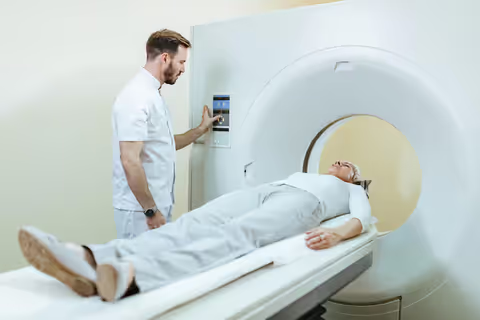
A CT scan machine is a medical imaging system that combines an X-ray source and detector array with computer-based image reconstruction.
During an examination, the scanner collects X-ray measurements from multiple angles. A computer processes this information to create cross-sectional images that can also be reconstructed into different planes or three-dimensional views.
CT imaging is used across areas such as:
- Emergency and trauma imaging
- Neurological imaging
- Cardiac imaging
- Oncology imaging
- Pulmonary imaging
- Vascular studies
- Musculoskeletal imaging
- Radiation therapy planning
The exact capabilities vary according to the CT system, software, clinical protocol, and healthcare facility.
Major CT Scan Machine Manufacturers
The global CT imaging market includes several established manufacturers. Their product ranges differ by technology and intended clinical applications.
GE HealthCare
GE HealthCare develops a range of computed tomography systems. Its CT portfolio includes conventional and advanced systems, with technologies addressing image quality, workflow, and newer approaches such as photon-counting CT.
Its portfolio demonstrates how CT manufacturers increasingly combine hardware with software and image-processing technologies.
Siemens Healthineers
Siemens Healthineers offers CT systems across several configurations, including multislice, dual-source, and photon-counting CT technologies. Its portfolio includes systems designed for different imaging requirements and clinical environments.
Siemens Healthineers also established a CT scanner production line at its Bengaluru facility in India under the country's Production Linked Incentive scheme.
Philips
Philips develops CT systems incorporating detector-based spectral CT and software technologies. Its CT portfolio is intended for applications including radiology, cardiology, oncology, neurology, trauma, and radiation oncology.
Canon Medical
Canon Medical offers several CT configurations under its Aquilion family. These include ultra-high-resolution CT, area-detector CT, multislice CT, large-bore CT, mobile CT, and photon-counting CT technologies.
Canon also develops deep-learning-based reconstruction technologies for CT imaging. Its portfolio illustrates the increasing role of software and artificial intelligence-assisted image reconstruction in modern scanners.
Types of CT Scanners
CT machines can be classified according to detector configuration, scanning technology, clinical application, and system design.
Single-Slice and Multislice CT
Multislice CT systems use multiple detector rows to collect imaging data during each rotation.
Common configurations can include:
- 16-slice CT
- 32-slice CT
- 64-slice CT
- 128-slice CT
- Higher detector configurations
The appropriate configuration depends on clinical requirements, examination types, workflow, and institutional needs.
Siemens Healthineers, for example, lists CT systems across multiple multislice configurations as part of its portfolio.
Dual-Source CT
Dual-source CT systems use two X-ray sources and two detector systems. This architecture can support specialized applications where high temporal resolution or advanced imaging capabilities are required.
Siemens Healthineers includes dual-source CT systems within its current CT portfolio.
Spectral CT
Spectral CT collects information that can be processed to provide additional material or energy-related information compared with conventional CT imaging.
This technology can support applications involving material differentiation and advanced image analysis.
Photon-Counting CT
Photon-counting CT represents a newer approach to CT detector technology. Instead of first converting X-rays into light and then into an electrical signal, photon-counting detectors directly measure individual X-ray photons and their energy.
This technology can support high spatial resolution and spectral imaging capabilities. Canon describes photon-counting CT as an emerging technology involving semiconductor-based detectors and advanced reconstruction methods.
Important CT Scanner Components
Understanding the main components helps explain differences between CT machine manufacturers.
X-Ray Tube
The X-ray tube produces the radiation used to create CT measurements. Tube design and operating characteristics influence scanning capability, image generation, and system performance.
Detector System
Detectors measure X-rays after they pass through the body. Detector design is one of the major factors distinguishing different generations of CT technology.
Gantry
The gantry contains major scanning components, including the X-ray tube and detector assembly. It rotates around the patient during image acquisition.
Patient Table
The motorized table positions the patient within the scanning area and moves according to the selected examination protocol.
Image Reconstruction Software
Reconstruction software converts collected measurement data into usable CT images. Modern systems may use iterative reconstruction, artificial intelligence-assisted reconstruction, or deep-learning approaches.
Computing Platform
CT scanners require substantial computing capabilities to process imaging data, reconstruct images, and support visualization applications.
Key Technologies Used in Modern CT Systems
Artificial Intelligence-Assisted Reconstruction
AI-assisted reconstruction is becoming increasingly important in CT imaging. These technologies can process imaging data using trained computational models and may be integrated into workflows for image reconstruction.
Manufacturers such as Canon Medical incorporate deep-learning reconstruction technologies into their CT platforms.
Low-Dose Imaging Technologies
Radiation dose management is an important consideration in CT imaging. Manufacturers develop hardware, software, exposure-control methods, and reconstruction techniques intended to support appropriate imaging while managing radiation exposure.
Dose performance should always be assessed according to the scanner configuration, protocol, patient characteristics, and applicable clinical standards.
Advanced Visualization
Modern CT platforms can provide tools for multiplanar reconstruction, three-dimensional visualization, vascular analysis, and other specialized applications.
These capabilities allow imaging data to be reviewed from different perspectives rather than relying only on axial images.
Workflow Automation
Automation can assist with patient positioning, scan planning, protocol selection, image reconstruction, and data processing.
The extent of automation varies between manufacturers and individual CT models.
How to Compare CT Scan Machine Manufacturers
A manufacturer comparison should consider technical specifications and the intended clinical environment rather than relying on a single feature.
Detector Configuration
Consider the number and design of detector rows, coverage, spatial resolution, and the types of examinations the system is designed to support.
Image Quality
Important technical factors can include spatial resolution, temporal resolution, contrast resolution, noise characteristics, reconstruction methods, and spectral imaging capabilities.
Radiation Dose Management
Evaluate the manufacturer's dose-management technologies and published technical information. Actual dose depends on examination protocols, patient characteristics, scanner settings, and clinical practice.
Clinical Applications
Different systems may be optimized for particular applications, including:
- Routine radiology
- Cardiac CT
- Neurology
- Oncology
- Trauma
- Vascular imaging
- Radiation therapy planning
Software and Connectivity
Healthcare facilities may also examine interoperability, image-management compatibility, DICOM support, visualization applications, and integration with existing hospital information systems.
Facility Requirements
A CT system also has physical and infrastructure requirements. These can include room dimensions, electrical infrastructure, cooling, radiation shielding, patient-access requirements, and installation considerations.
CT Scan Machine Manufacturers and Healthcare Technology
The CT industry has gradually moved from basic cross-sectional imaging toward increasingly integrated imaging platforms.
Modern CT systems can combine:
- Advanced detector technologies
- High-performance computing
- Automated scanning workflows
- AI-assisted image reconstruction
- Spectral imaging
- Three-dimensional visualization
- Dose-management technologies
- Digital healthcare connectivity
This development means that evaluating a CT system involves more than comparing the number of slices alone.
High-Value SEO Keywords for This Topic
For an informational healthcare-technology article, relevant commercial-intent keywords can be incorporated naturally without making promotional claims.
Short Keywords
- CT scan machine
- CT scanner
- CT imaging
- CT technology
- CT machine manufacturers
- medical imaging
- diagnostic imaging
- computed tomography
Long-Tail Keywords
- CT scan machine manufacturers
- leading CT scanner manufacturers
- computed tomography machine manufacturers
- CT scanner technology explained
- types of CT scan machines
- multislice CT scanner technology
- photon counting CT technology
- medical imaging equipment manufacturers
- CT scanner components explained
- advanced CT imaging systems
Keywords should be used naturally in headings and paragraphs. Avoid repeating the same keyword excessively because useful information should remain the primary purpose of the page.
Factors That Influence CT Scanner Selection
Healthcare organizations generally consider several technical and operational factors when evaluating CT equipment.
Important considerations may include:
- Clinical workload
- Required imaging applications
- Detector configuration
- Spatial and temporal resolution
- Radiation dose management
- Image reconstruction technology
- Workflow requirements
- Software capabilities
- Data connectivity
- Room and infrastructure requirements
- Training requirements
- Regulatory considerations
- Long-term equipment support
The most appropriate specifications depend on the facility's clinical requirements and applicable medical-device regulations.
Regulatory and Safety Considerations
CT scanners are medical devices and are subject to regulatory requirements that vary by country.
Healthcare organizations should verify applicable requirements from the relevant national or regional regulatory authorities before implementing medical imaging equipment.
Information published by manufacturers should also be interpreted in the context of the specific model and market because product availability and regulatory status can differ between countries. Canon, for example, notes that not all products displayed on its global website are available in every market.
Frequently Asked Questions
What is a CT scan machine manufacturer?
A CT scan machine manufacturer develops and produces computed tomography systems used to acquire and process X-ray-based medical images.
What are the main types of CT scanners?
Common categories include multislice CT, dual-source CT, spectral CT, large-bore CT, area-detector CT, ultra-high-resolution CT, and photon-counting CT.
What is a multislice CT scanner?
A multislice CT scanner uses multiple detector rows to collect imaging information during a rotation. Different systems can have different detector configurations and capabilities.
What is photon-counting CT?
Photon-counting CT uses detectors capable of measuring individual X-ray photons and their energy. It represents a newer detector approach within computed tomography.
Why is CT software important?
CT software supports image reconstruction, visualization, workflow management, and specialized image analysis. Modern scanners increasingly integrate software with hardware to support different imaging workflows.
Are all CT scanners the same?
No. CT scanners differ in detector technology, scanning configuration, image reconstruction, software, clinical applications, physical design, and workflow capabilities.
Conclusion
CT scan machine manufacturers play an important role in the development of modern diagnostic imaging technology. Companies such as GE HealthCare, Siemens Healthineers, Philips, and Canon Medical offer CT platforms covering different configurations and technologies.
The CT industry continues to evolve through technologies such as multislice imaging, spectral CT, AI-assisted reconstruction, ultra-high-resolution imaging, and photon-counting detectors.
For an informative comparison, readers should examine technical specifications, intended clinical applications, image-reconstruction technologies, radiation-management features, software capabilities, infrastructure requirements, and applicable regulatory information rather than focusing on a single specification.
Editorial/AdSense note: This article is written as educational medical-technology content and does not diagnose conditions, recommend treatment, or make unsupported claims about medical outcomes. Google states that publishers must comply with its current Publisher Policies and that policy requirements can change over time.